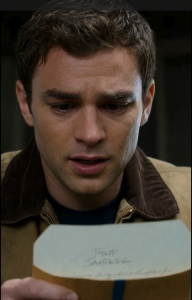
The rain in Pine Ridge, Oregon, always felt like it was trying to wash away secrets. For as long as I could remember, the old, dilapidated house on the northern ridge belonged to Frank Vance. He was a retired Marine, a towering man with a silver buzz cut and a scowl that could stop a chainsaw. The town folklore said he hated people, hated noise, and mostly, hated kids. We grew up being told never to step foot on his gravel driveway.
So, when the local attorney, Mr. Harrison, called my cell phone three days after Frank passed away, I assumed it was a mistake.
“Ethan Cross?” the lawyer’s voice boomed over the receiver. “I need you to come down to my office. It’s regarding the estate of Frank Vance.”
I sat in the leather chair across from Mr. Harrison, still wearing my oil-stained canvas work jacket from the local auto shop. The lawyer slid a heavy brass key across the mahogany desk.
“Frank left you his garage,” Mr. Harrison said flatly. “More specifically, the vehicle inside it.”
My jaw dropped. “The ’68 Mustang? Sir, I’ve never spoken more than two words to the man. Why would he leave me a car worth eighty thousand dollars?”
“He didn’t leave an explanation,” the lawyer replied, adjusting his spectacles. “Just a stipulation that you take possession immediately.”
Word travels fast in a town of four thousand people. By the time I towed the covered vehicle back to my small rented garage, my phone was blowing up. People were furious. Rumors spread that I had scammed a dying old man, or that Frank had lost his mind in his final days.
When I finally pulled the dusty canvas cover off the car, the breath caught in my throat. It was a Highland Green 1968 Ford Mustang Fastback. The paint was immaculate, the chrome gleamed like new money, and the interior smelled of rich, aged leather and vintage gasoline. Frank had spent thirty years restoring this machine, yet no one had ever seen him drive it.
I sat in the driver’s seat, gripping the wooden steering wheel. I felt like a thief. I didn’t deserve this.
Deciding to give the car a thorough inspection, I grabbed my tools and began checking the wiring underneath the dashboard. As I reached up behind the glove box to inspect the radio housing, my fingers brushed against a strange metal lever. It wasn’t factory standard.
Curiosity took over. I pulled the lever.
With a soft click, a hidden, carpeted panel behind the glove box dropped open. My heart began to hammer against my ribs. Reaching inside, I pulled out a thick, heavy manila envelope wrapped in a faded blue ribbon. On the front, written in rigid, military-style cursive, were three words:
For Sarah Cross.
Sarah Cross is my mother.
My hands shook as I untied the ribbon. Inside was a stack of local newspaper clippings from December 2003 and a handwritten letter dated the exact same month. I unfolded the yellowed paper and began to read.
Sarah,
If you are reading this, it means I am finally gone, and the boy has found this car. By now, the town has probably spent decades calling me a monster, a recluse, a bitter old man. I let them believe it. It was easier that way.
Twenty-three years ago, on the night of December 14th, a brutal blizzard hit the ridge. I was driving home when I saw tail lights flipped upside down in the freezing waters of the Blackwood River. I jumped into the rapids. The driver was a young mother, knocked unconscious. In the backseat, buckled into a car seat, was a three-year-old boy, screaming as the water rose to his chin.
I managed to smash the back window. I pulled the little boy out first, dragging him to the icy bank. But when I turned back to get the mother, the current swept the car deeper into the river. I dove back in, fighting the freezing black water, and barely managed to drag her to safety just before the car was completely submerged.
I stopped reading, the breath completely knocked out of me. Tears blurred my vision. I knew this story. When I was three years old, my mother and I were in a near-fatal car accident. She had always told me that a “phantom angel” had pulled us from the river and vanished into the storm before the paramedics arrived. She had spent the last two decades wondering who saved our lives.
It was Frank Vance.
But as I kept reading, the true, heartbreaking weight of the letter revealed itself.
The paramedics arrived and took you and your son to the hospital. You both survived. But what the police reports never showed was what happened on the bridge above you.
My eighteen-year-old son, Jimmy, was in the passenger seat of my truck that night. When he saw me diving into the river, he panicked. He tried to climb down the icy embankment to help me. He slipped. He fell thirty feet onto the jagged rocks below the bridge.
By the time the ambulances arrived, my boy was gone.
A sob caught in my throat. The garage around me fell completely silent, save for the rhythmic patter of the Oregon rain on the tin roof.
For years, I looked at you and your son, Ethan, walking through town. Every time I saw Ethan grow a foot taller, graduate high school, and become a fine young man, I saw the ghost of the life my Jimmy never got to live. I isolated myself because looking at your family’s happiness was a knife in my heart, yet watching over you both was the only thing keeping me alive.
This Mustang was the car Jimmy and I were building together before the river took him. I finished it for him. But I am leaving it to Ethan. Because every time I wanted to give up on this life, I looked down from the ridge, saw Ethan working hard, and knew that my son’s sacrifice wasn’t in vain.
Please forgive me for being a stranger. It was the only way I knew how to survive the grief.
Semper Fi, Frank Vance
I sat in the green Mustang for a long time, the letter clutched against my chest, letting the tears fall freely. The man the entire town had judged, the man we had all feared and mocked as kids, had spent twenty-three years living in a prison of silent grief, carrying a burden no father should ever have to bear. He had traded his son’s life for mine.
Ten minutes later, I drove the pristine 1968 Mustang out of the garage and down the wet asphalt roads of Pine Ridge. I pulled into the driveway of my mother’s small house.
When she came to the door, her eyes widened at the sight of the legendary car. But she didn’t look at the vehicle for long. She looked at my tear-stained face.
I walked up the porch steps, handed her the faded manila envelope, and wrapped my arms around her. “Mom,” I whispered, my voice breaking. “We finally know who saved us.”
The next morning, my mother and I drove the Mustang up to the veterans’ cemetery on the hill. We placed a fresh bouquet of pine boughs and a small, miniature model of a green Mustang right next to Frank Vance’s headstone.
True heroes don’t always wear capes, and they don’t always look like the saints we expect them to be. Sometimes, they carry their scars in total silence, hidden away in the dark, waiting for the right moment to let the light back in.
